
Enterprise Systems Engineering Should Meet You Where You Already Work
Over the past few months, we’ve expanded SysGit’s enterprise Git support to include Azure DevOps, Bitbucket Data Center, and GitHub Enterprise Server.
Over the past few months, we’ve expanded SysGit’s enterprise Git support to include Azure DevOps, Bitbucket Data Center, and GitHub Enterprise Server. On the surface, these are integrations, but taken together they represent something more fundamental about how we think modern systems engineering software should fit into an enterprise environment.
Large engineering organizations have already spent years building secure, governed, highly controlled development infrastructure. They have standardized identity and access management, established network boundaries, built audit and approval workflows, deployed CI/CD systems, and selected the Git platforms their teams rely on every day. Systems engineering software shouldn’t require them to recreate all of that infrastructure in a separate environment just to manage a system model.
That is one of the core ideas behind SysGit. Rather than building a proprietary, “Git-like” version-control system specifically for MBSE, SysGit uses Git itself as the underlying source of truth for SysML v2 models. Because SysML v2 provides a standardized textual representation of the system model, those models can be stored and managed as ordinary files inside the same repositories and infrastructure that organizations already use for software and other engineering artifacts.
For one customer, that might mean GitHub Enterprise Server running inside a private network. For another, it might mean Azure DevOps as the standard development platform across the organization. For another, it might mean an internally operated Bitbucket Data Center deployment that integrates with their Atlassian toolsuite. We don’t think enterprises should have to adopt our preferred Git platform in order to use SysGit. The goal is to meet them where their engineering already happens.
Git as the Integration Layer
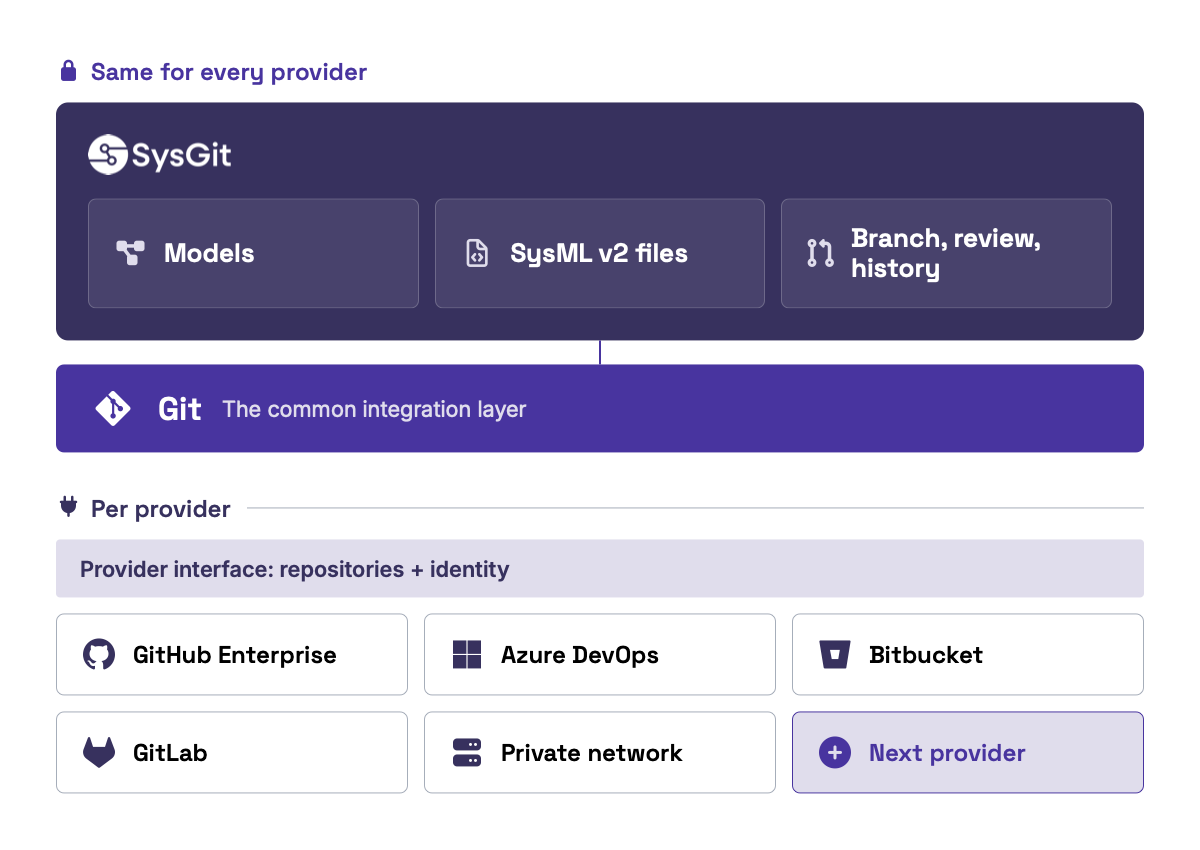
This architecture also makes it much easier for SysGit to support new enterprise environments. Because Git provides the underlying version-control abstraction, adding support for another provider does not require rethinking how SysGit handles models, branches, commits, reviews, or history.
The modeling layer remains the same. The SysML v2 files remain the same. The concepts of branching, merging, reviewing changes, and tracing a model back through its history remain the same. What changes is primarily the interface to the customer’s existing repository and identity infrastructure.
That distinction matters because there is no single Git platform that dominates every enterprise environment. Some organizations have standardized on GitHub Enterprise, while others are deeply invested in Azure DevOps or Atlassian tooling. Some operate entirely inside private networks, while others use managed cloud services with strict identity and governance requirements. There will always be another provider, another deployment model, or another security constraint to support.
SysGit was designed for that reality. We want supporting a new Git environment to be an extension of the platform, not a reinvention of it.
Security Requirements Are Architecture Requirements
For many of the organizations we work with, particularly in aerospace, defense, automotive, and other highly regulated industries, deployment architecture is not a secondary consideration. It can determine whether a tool can be used at all.
Engineering data may need to remain entirely on-premises or inside a private cloud. Access may need to be controlled through an enterprise identity provider. Systems may need to operate inside restricted networks, and organizations may have strict requirements around auditability, backups, data residency, and external connectivity.
In those environments, “secure” cannot simply mean that a vendor has implemented good security practices in its own SaaS platform. Often, the more important question is whether the software can operate within the security architecture the customer already controls.
That is where SysGit’s Git-native approach provides an important advantage. If an organization already operates GitHub Enterprise Server, Bitbucket Data Center, Azure DevOps, or another approved Git environment, its system models can remain inside that infrastructure. The customer continues to control where the repositories live, who can access them, how authentication works, how backups are handled, and what network boundaries surround the system.
SysGit does not need to become another isolated repository of sensitive engineering data. Instead, it can operate as part of an environment the organization has already secured and governed.
Bringing Systems Engineering Into the Existing Engineering Lifecycle
There is another benefit to this architecture that goes beyond deployment and security. When system models live in the same infrastructure as software, they can participate in many of the same engineering workflows.
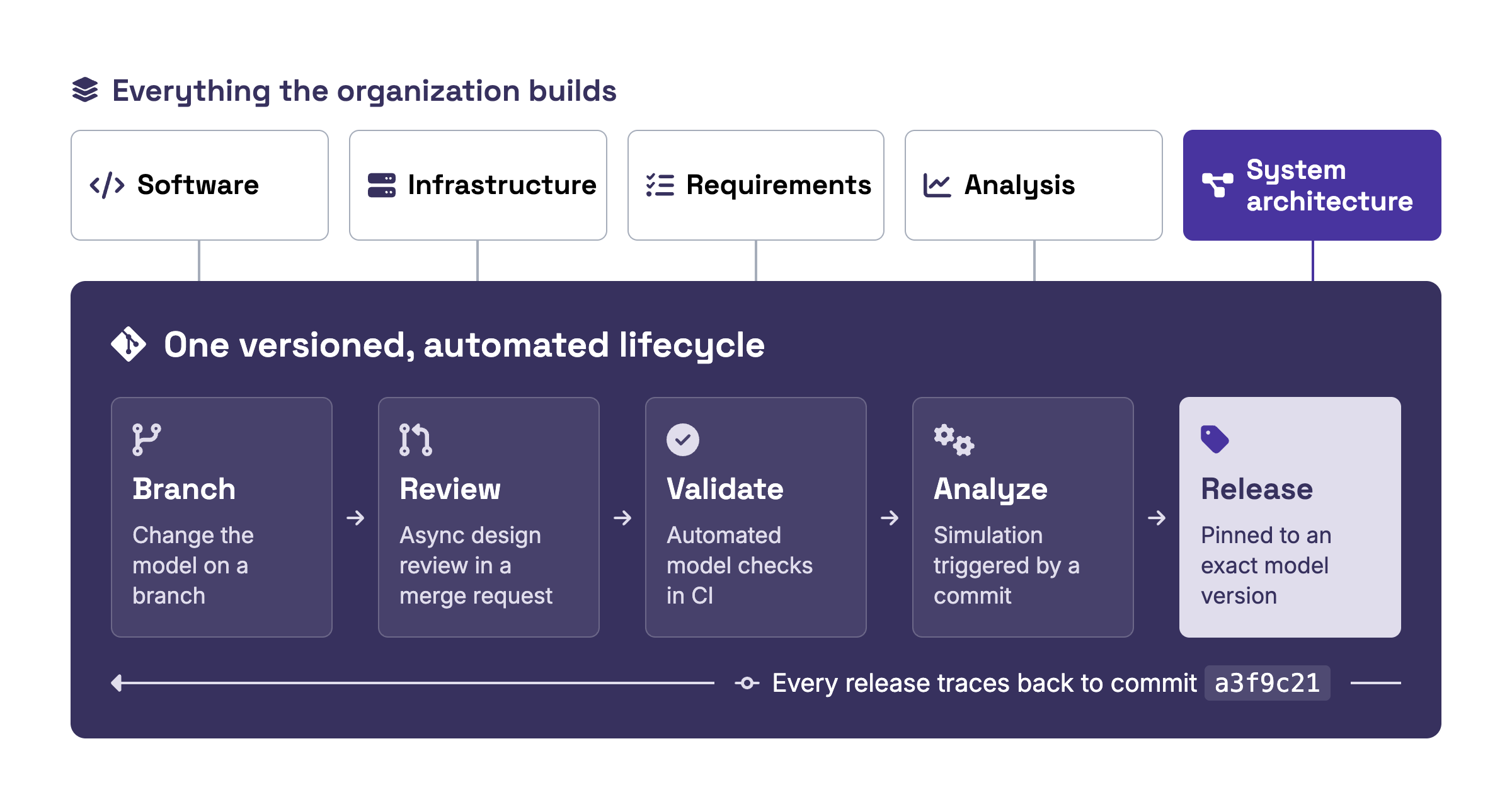
A model change can happen on a branch and be reviewed through a pull request or merge request. Automated validation can run against the model in CI. Simulation or analysis workflows can be triggered from a commit. Releases can point back to the exact version of the system architecture from which they were produced. Design reviews can be conducted asynchronously, leveraging the merge request workflows powering modern day software development.
More importantly, the system model no longer has to exist as a separate island from the rest of the engineering organization. Software, infrastructure, requirements, analysis, and system architecture can increasingly participate in the same versioned and automated development lifecycle.
We think this is an important direction for digital engineering. The goal should not be to rebuild decades of software development infrastructure inside every systems engineering application. It should be to let systems engineering participate directly in infrastructure that already exists and already works.
Open Formats, Existing Infrastructure
The addition of Azure DevOps, Bitbucket Data Center, and GitHub Enterprise Server is another step in that direction, and we expect the list to continue growing. The important part is not any individual Git provider. It is the ability for an organization to adopt modern systems modeling without having to redesign the rest of its engineering environment around it.
SysML v2 gives us an open, textual representation of the system. Git gives us a proven foundation for version control, collaboration, automation, and traceability. SysGit brings those two together in a way that fits naturally into enterprise engineering environments.
Your models. Your Git. Your infrastructure.